


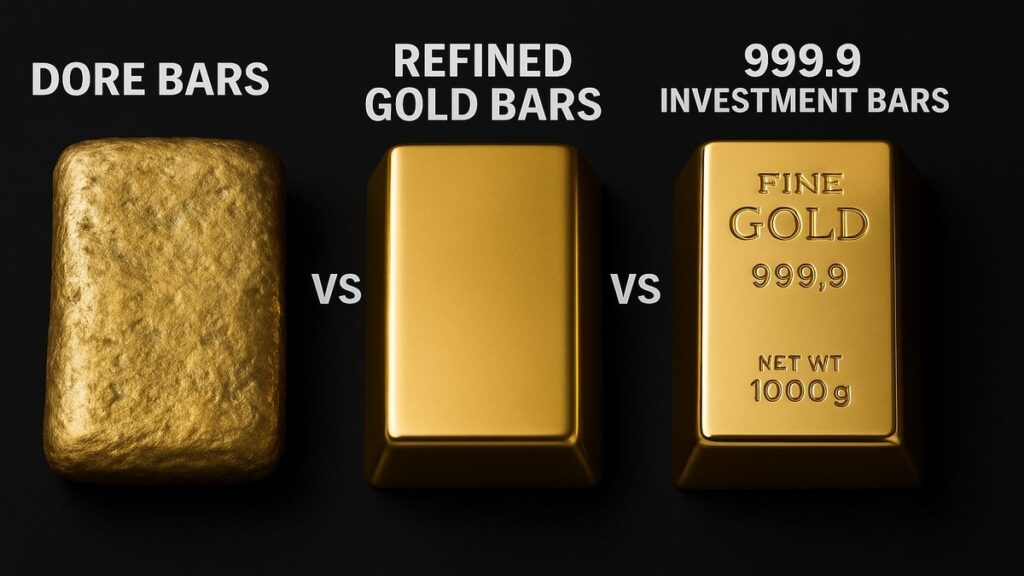
If you’re serious about gold, you’ve probably seen all three terms:
- Dore bars
- Refined gold bars
- 999.9 investment bars
They all contain gold, but they’re not the same product, and they’re not designed for the same type of buyer.
This guide breaks down, in practical language:
- What each bar type actually is
- Who usually buys it (refinery, trader, long-term investor)
- The risks and advantages of each
- How Congo Rare Minerals can supply each category, depending on your profile
By the end, you should know exactly which type of bar you should be asking for when you speak with a gold bar supplier.
1. Quick Definitions: Dore, Refined & 999.9 Investment Bars
What are Dore Bars?
Dore bars are partially refined metal, poured near the mine site from gold-bearing ore or scrap.
Typical features: (BullionByPost)
- Mix of gold + silver + base metals (copper, zinc, etc.)
- Gold content often around 50–90% (many sit near 70–80%)
- Rough, matte surfaces, irregular shapes, not “pretty” bullion
- Poured at or near the mine to make transport easier
Dore bars are not an end product. They’re feedstock for refineries, which later turn them into high-purity bullion.
In short: Dore bars = semi-pure mine output, mainly for refineries and large industrial buyers, not small investors.
What are Refined Gold Bars?
Refined gold bars are bars that have gone through a full refining process (smelting + chemical/electrolytic refining) to reach investment-grade purity, typically 995–999.9 fine. (Gold Bars Worldwide)
They can be:
- Cast bars – poured into a mold, slightly rougher surface, usually larger sizes
- Minted bars – cut from rolled gold and struck, very clean edges and surfaces
Refined bars can be produced by:
- LBMA-accredited refineries (these can be accepted as “Good Delivery” in the London OTC market) (LBMA)
- Or non-LBMA refineries that still meet high technical purity standards
These bars are what most people think of when they say “buy gold bullion”.
What are 999.9 Investment Bars?
999.9 gold bars (often called “four-nines fine”) are a subcategory of refined bars with 99.99% purity, or 999.9 parts gold per 1,000. (Royal Mint)
Key points:
- 999 = 99.90% pure
- 999.9 = 99.99% pure, leaving just 0.01% trace metals
- Many LBMA gold bars and top-tier investment bars are 999.9
These usually come as certified gold bars from known mints/refineries, often with:
- Serial number
- Refiner’s stamp
- Fineness mark (e.g. “999.9 FINE GOLD”)
- Assay card or certificate (Gold Silver Shop 24)
In short: 999.9 investment bars are the clean, branded bullion bars that long-term investors, wealth managers and family offices typically want to hold.
2. Certified Gold Bars, LBMA Standards & Why They Matter
When you see “certified gold bars”, you’re usually dealing with bars that:
- Come from a recognized refinery or mint
- Meet a documented fineness (995, 999, 999.9, etc.)
- Are backed by an assay and serial number
- Often trace back to an LBMA Good Delivery refiner for extra credibility (LBMA)
The London Bullion Market Association (LBMA) sets Good Delivery standards for bars used in the global OTC market:
- Standard 400 oz (≈12.5 kg) “Good Delivery” bars
- Fineness typically 995.0–999.9
- Strict rules on marking, dimensions and responsible sourcing (Gold Bars Worldwide)
For smaller bars (1kg, 100g, etc.), “LBMA gold bars” usually means:
- The refiner is on the LBMA list
- The bar’s fineness (often 999.9) and branding are trusted
- Liquidity and resale are easier, especially in Europe, Dubai, London and major Asian hubs (StonexBullion)
That’s why serious investors and institutions usually insist on LBMA-linked certification somewhere in the chain.
3. Side-by-Side: Dore Bars vs Refined Bars vs 999.9 Investment Bars
Here’s the practical comparison you actually care about:
| Feature | Dore Bars | Refined Gold Bars | 999.9 Investment Bars |
|---|---|---|---|
| Typical purity | ~50–90% gold, plus silver/base metals (StonexBullion) | ≥ 995 fine (99.5%+) (Gold Bars Worldwide) | 999.9 fine (99.99% gold) (Royal Mint) |
| Typical look | Rough, matte, irregular | Cast or minted, more uniform | Highly polished, branded, serialised |
| Main buyers | Refineries, large industrial buyers | Refineries, wholesalers, some investors | Private investors, family offices, funds, dealers |
| Main purpose | Feedstock to be refined | Trade, fabrication, or investment | Long-term investment / wealth storage |
| Docs & branding | Basic weight/purity notes; not “retail-ready” | Varies: may have basic markings and assay | Full certification, assay, serials; easy to verify (Gold Silver Shop 24) |
| Risk profile | Higher technical & compliance risk if you’re not a refinery | Depends on refiner and documentation | Lowest complexity for non-technical investors |
So if you’re asking “Which should I actually buy?” and you’re not a refinery, the answer is usually:
- Not dore
- Yes to refined bars, and ideally
- Yes to 999.9 certified bars, especially if you want clean documentation and easy resale
4. Who Each Bar Type Is Really For
4.1. Dore Bars – For Refineries and Very Experienced Traders
Best suited for:
- Refineries and smelters
- Industrial groups with in-house refining capacity
- Very experienced traders who have guaranteed refinery partners
Why:
- You must handle variable purity, pay refining charges, and manage recovery of gold, silver and other metals
- You carry more assay and compliance risk if you can’t test independently (BullionByPost)
For a new investor, dore is usually too technical and risky. You’re better off letting a refinery (or a supplier like Congo Rare Minerals working with refiners) handle that stage.
4.2. Refined Gold Bars – For Traders, Dealers & Some Investors
Best suited for:
- Bullion traders and dealers
- Regional wholesalers
- Some high-net-worth individuals comfortable with slightly lower purity (e.g. 995) if liquidity is strong
Pros:
- High purity, easier to price against spot
- Often better premiums than coins or very small bars
- Can be recast into branded or smaller bars later
Cons:
- Not all refined bars are equal – some come from lesser-known refiners, which can affect resale
- Documentation quality varies: you want an assay, clear markings and provenance (Gold Bars Worldwide)
If you’re comfortable reading refinery docs and negotiating with multiple buyers, refined bars (even if not 999.9) can work well.
4.3. 999.9 Investment Bars – For Long-Term, Non-Technical Investors
Best suited for:
- Long-term private investors
- Family offices and wealth managers
- Institutions that want clean, easily auditable bullion
Why 999.9 bars stand out:
- Top-tier purity (99.99% gold)
- Strong recognition with mints, refiners and depositories globally (Royal Mint)
- Often linked to LBMA-accredited refiners
- Serial numbers, assay cards and certificates simplify audits and resale
If your main goal is to buy gold bullion once and hold it quietly for years, 999.9 investment bars are usually the cleanest solution.
5. How Congo Rare Minerals Fits Into Each Category
Congo Rare Minerals (CRM) sits close to the source in North Kivu, DRC, with export routes via Uganda, supplying gold to buyers in Europe, the USA, Dubai, China and other hubs. (https://marketing.congorareminerals.com/)
Because they’re upstream, they see all three stages of the chain.
5.1. Dore Bars from Congo Rare Minerals
CRM works with Congolese production that can be supplied as gold dore bars, particularly for: (TradeKey)
- Refineries in Africa, the Middle East, Europe and Asia
- Large industrial buyers who already have refining arrangements
If you’re a refinery or industrial buyer, CRM can:
- Provide dore bars with documented origin
- Coordinate export permits and logistics from DRC/Uganda to your refinery
- Align with your preferred assay protocol
For retail or first-time buyers, CRM will usually not recommend dore, because of the technical and compliance burden.
5.2. Refined Gold Bars from CRM
CRM can also deliver refined gold bars once dore has been processed:
- Bars in standard investor sizes (100g, 250g, 500g, 1kg, and higher)
- Purity typically 22K or 24K, with fineness specified in the contract
- Supplied with assay reports, invoice, export permits and supporting documentation (https://marketing.congorareminerals.com/)
These refined bars are what most CRM clients mean when they buy gold bullion for investment or trading.
5.3. 999.9 Investment Bars & LBMA-Linked Product
In addition, CRM works with LBMA-connected refining partners to provide 999.9 certified gold bars to international buyers, combining: (Buy Gold Bars)
- Four-nines fine (99.99%) purity
- Serialised bars with refiner’s stamp
- Documentation suitable for vaults, private banks and professional storage companies
This is the layer that appeals most to:
- Private investors wanting long-term 999.9 gold bars
- Family offices looking for LBMA gold bars in specific sizes
- Dealers who want to resell small, branded bars domestically
In other words, CRM can support you whether you need:
- Dore bars to feed a refinery
- Refined bars for trading
- Or 999.9 investment bars for long-term holdings
6. How To Decide What You Should Actually Buy
Here’s a simple decision tree you can use:
Question 1: Are you a refinery or do you control one?
- Yes → You can consider dore bars, provided you’re comfortable with sourcing, refining cost and compliance.
- No → Skip dore. You want refined or 999.9 certified bars instead.
Question 2: Do you mainly care about maximizing margin as a trader?
- Yes → Refined gold bars (995–999.9) from reputable refiners can work well, especially in kilo or multi-kilo lots.
- No → Move toward fully certified 999.9 investment bars for simplicity.
Question 3: Are you a long-term wealth holder?
- Yes → Default to 999.9 gold bars in sizes that fit your ticket: 100g–1kg, with clear documentation and storage in a professional vault.
- No, I’m more opportunistic → Refined bars may be enough, as long as the refiner and paperwork are strong.
Question 4: Are you new to physical gold?
If you’re new, your safest path is usually:
- Start with certified 999.9 bars from a recognized gold bar supplier like Congo Rare Minerals (via its refining partners).
- Use simple sizes like 100g, 250g or 1kg.
- Keep all documentation and store the bars with a professional vault or bank depository.
Once you’re comfortable, you can explore more complex structures (wholesale, dore, etc.) if it fits your business model.
7. FAQs: Dore Bars, Refined Bars, and 999.9 Investment Bars
1) Can a private investor safely buy dore bars?
Technically, yes – but it’s rarely a good idea.
Dore bars are unfinished metal with variable purity, intended for professional refineries. To make them work as an investment, you’d need: (StonexBullion)
- A trusted refining partner
- Clear refining cost structure
- Reliable assays and strong compliance
For most private investors, it’s simpler and safer to buy refined or 999.9 certified bars instead.
2) Are 999.9 gold bars really better than 999 or 995 bars?
From a purity perspective, yes:
- 995 = 99.5% gold
- 999 = 99.9% gold
- 999.9 = 99.99% gold, only 0.01% trace metals (Cheshire Gold Xchange)
In practice, though, what matters most is:
- Whether the bar is recognised and trusted (refiner brand, LBMA link)
- Whether documentation is complete for storage and resale
So 999.9 from a serious refiner is ideal, but a well-recognised 999 or 995 bar from an LBMA-listed refiner can also be very liquid.
3) What exactly are “certified gold bars”?
“Certified” usually means:
- The bar’s fineness has been tested and documented
- It carries a refiner or mint stamp, a fineness mark (e.g. 999.9) and often a serial number
- It is accompanied by an assay card or certificate from a recognized entity (Gold Silver Shop 24)
This makes it much easier to:
- Place the bar in a vault or bank
- Sell it later to dealers or institutions
- Prove authenticity during audits
4) How does Congo Rare Minerals help me choose the right type?
When you speak to CRM, they’ll usually start by asking:
- Are you a refinery, trader, or investor?
- What’s your target destination (Dubai, Europe, USA, Asia, etc.)?
- What’s your ticket size (e.g. 1kg, 5kg, 10kg+)?
Then they’ll steer you toward:
- Dore bars if you’re a refinery
- Refined bars if you’re trading or fabricating
- 999.9 investment bars if you’re building long-term holdings and want clean, certified bullion sourced from DRC/Uganda with proper documentation (https://marketing.congorareminerals.com/)
5) If I want to buy 999.9 investment bars from CRM, what’s the process?
In simple terms:
- Share your profile & target size (e.g. “I want to buy bullion bars worth about X USD.”)
- CRM prepares a formal quote / pro forma invoice with the bar type (999.9), quantity, route, and costs.
- After KYC and payment, the bars are prepared, documented, insured and shipped to your chosen vault, bank or refinery.
If you’re ready to move from theory to practice, your next step is to speak with Congo Rare Minerals and clarify which bar type matches your actual use case: dore, refined, or fully certified 999.9 investment bars.