


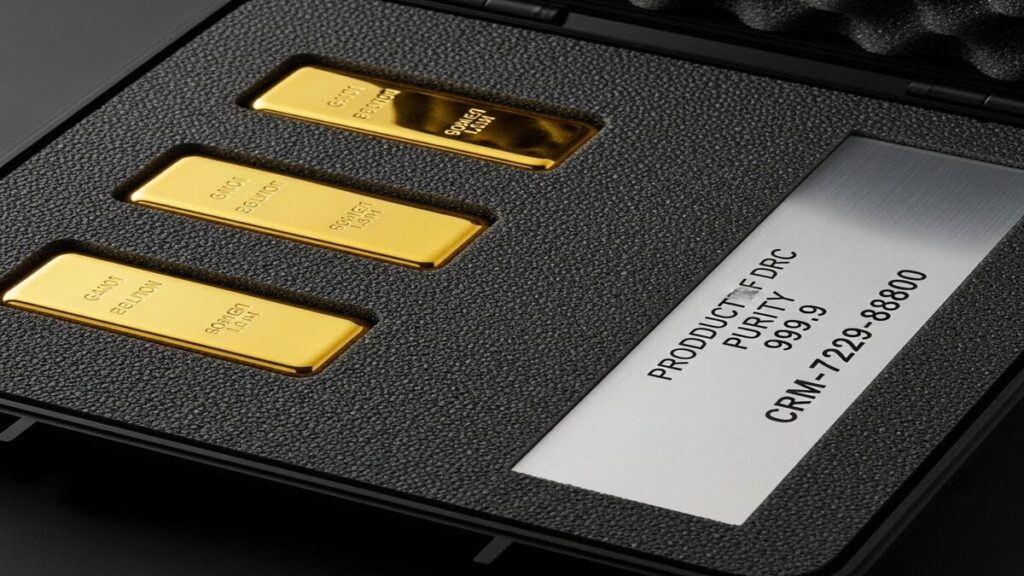
If you’ve ever searched for “cheap gold online”, you already know the problem: low prices usually trigger a red flag. So it’s fair to ask:
Why does Congo Rare Minerals list investment gold at prices like $85,000 for a 1 kg 24K (999.9) bar and $9,000 for 100 g on our Shop? (Congo Rare Minerals)
Here’s the honest answer: the pricing isn’t “cheap” because quality is lower. It’s efficient because the sourcing model is different.
As of today, the CRM Shop lists these reference prices: (Congo Rare Minerals)
| Product | Listed price |
|---|---|
| 1 Kilogram of Gold | $85,000 |
| 500 Grams of Gold | $43,000 |
| 250 Grams of Gold | $22,000 |
| 100 Grams of Gold | $9,000 |
| 5 Kilograms of Gold | $425,000 |
| 10 Kilograms of Gold | $800,000 |
This post explains why those numbers can be competitive when you buy gold in Africa, and what makes them a trust signal instead of a warning sign.
The big idea: “affordable” should mean fewer markups, not fewer standards
Most buyers pay extra for things that don’t improve the gold at all:
- broker fees
- consolidator margins
- repeated handling and re-selling across multiple “middle layers”
- retail dealer overhead and branding premiums
CRM’s model is built around being a primary buyer in North Kivu and sourcing through a wide network of small-scale miners across the region (the bulk of local production). That scale lets CRM price like a direct-source supplier, not like a retail chain with multiple markups.
So the question isn’t “Why is this so cheap?”
It’s: “How many markups did I avoid?”
Traditional model vs. CRM model
Below is the simplest way to compare what you’re paying for.
| Step | Traditional chain | CRM direct-source chain |
|---|---|---|
| Sourcing | Miner → local broker → consolidator | Miner network → CRM aggregation |
| Pricing | Layered margins + opaque spreads | Direct source gold prices anchored to a clear model |
| Handling | Multiple handoffs increase cost + delay | Fewer handoffs reduce cost + risk |
| Documentation | Often inconsistent between parties | Standardized export-grade document pack per shipment (Congo Rare Minerals) |
| Buyer experience | Negotiation-heavy, unclear totals | Public reference pricing + formal quotes for settlement |
That’s the core: you’re not paying less for lower quality — you’re paying less for fewer toll booths.
Why scale matters in North Kivu gold (and why small sellers can’t match it)
When a company becomes a consistent, high-volume buyer in a producing region, it creates three advantages that show up directly in price:
1) Consistent supply beats “opportunity sourcing”
Small traders often buy opportunistically. That means uneven supply, higher per-unit costs, and more reliance on brokers.
CRM’s regional purchasing scale stabilizes supply flow, which reduces “panic premiums” and last-minute sourcing costs.
2) Economies of aggregation
Buying in volume lowers the average cost of:
- collection and secure transport from mine areas
- sorting and batching
- assaying workflow coordination
- vault and export preparation
That’s exactly how buy gold wholesale pricing becomes possible for serious buyers.
3) Faster turnaround reduces hidden costs
Time is money in bullion. Faster cycles reduce:
- storage time
- repeated security handling
- avoidable delays that turn into fees
Why 24K and 22K can both be “good value” (and why the price gap is normal)
One reason pricing confusion happens: many people compare gross weight without comparing fine gold content.
- 24K is essentially pure gold (often ~999–999.9 fineness).
- 22K is ~916 fineness (about 91.67% gold content). (Congo Rare Minerals)
That means 1 kg of 22K contains less fine gold than 1 kg of 24K, so a lower price is mathematically normal if pricing is based on fine content. (Congo Rare Minerals)
This is also why you may see 22K quoted lower (for example, buyers sometimes reference ~$75,000/kg in older spot conditions or lower-fineness structures), while 24K 999.9 can sit higher (like the current $85,000 listing for a 1 kg 999.9 bar). (Congo Rare Minerals)
Bottom line: if someone offers “24K pricing” but delivers “22K content,” that’s a problem. CRM separates the options clearly and uses proper purity math. (Congo Rare Minerals)
Addressing the skepticism head-on: “If it’s affordable, what’s the catch?”
Here’s the cleanest way to think about it:
The catch is not in the gold. The catch is usually in the paperwork, the assay, or the handoffs.
That’s why CRM ties competitive pricing to documentation and verification.
For example, the 1 kg 999.9 (24K) serialized bar listing states it includes:
- CEEC government export license
- independent assay certificate
- certificate of origin
- commercial invoice + legal transit documents (Congo Rare Minerals)
It also describes insured, customs-cleared shipping to major hubs and tamper-evident packaging to a nominated refinery or secure vault. (Congo Rare Minerals)
On the responsible mining side, CRM also positions its operations around conflict-free sourcing, traceability, and independent assays with compliance alignment for major trade ecosystems. (Congo Rare Minerals)
So the trust message is simple:
You’re not paying less because standards are missing. You’re paying less because extra markups are missing.
What “transparent pricing” looks like when you buy gold online
Most exporters won’t publish prices publicly because they can’t keep supply steady enough to stand behind a consistent model.
CRM does publish reference prices on the Shop, and that’s part of the point: it makes pricing less opaque for first-time buyers and cost-conscious investors who still want verification and structure. (Congo Rare Minerals)
If you’re comparing offers, compare these three things together:
- Purity (999.9 / 995 / 22K) (Congo Rare Minerals)
- Proof (assay + export documentation + chain consistency) (Congo Rare Minerals)
- Total delivery structure (insured logistics + destination handling) (Congo Rare Minerals)
That’s how you separate “cheap gold online” marketing from affordable gold bars with real settlement integrity.
Call to action: see today’s value, then request your volume quote
If you’re ready to buy gold in Africa at efficient, direct-source pricing, start here:
- Visit the CRM Shop to see today’s reference prices and available bar sizes. (Congo Rare Minerals)
- If you’re buying larger volume (or need institutional terms), contact Sales for a personalized, volume-based quote and the exact documentation pack for your destination route.
You’re not paying less for lower quality. You’re paying less for fewer markups.